
Clean Beauty, Reviva Labs, Skin Care
What Are Sebaceous Glands and How They Shape Your Skin

May
Your skin runs a quiet, around the clock manufacturing operation that most people never think about. Tucked into the second layer of your skin sit hundreds of thousands of microscopic glands, and according to clinical dermatology references published through StatPearls, these glands supply roughly 90 percent of the lipids that sit on your skin’s surface. That single figure reframes how we should think about facial oil. The slick feeling you notice by midday is not a flaw or an accident. It is the visible end of a biological process that has been keeping skin soft, sealed, and resilient for as long as humans have existed.
The Tiny Oil Factories Hiding Beneath Your Skin
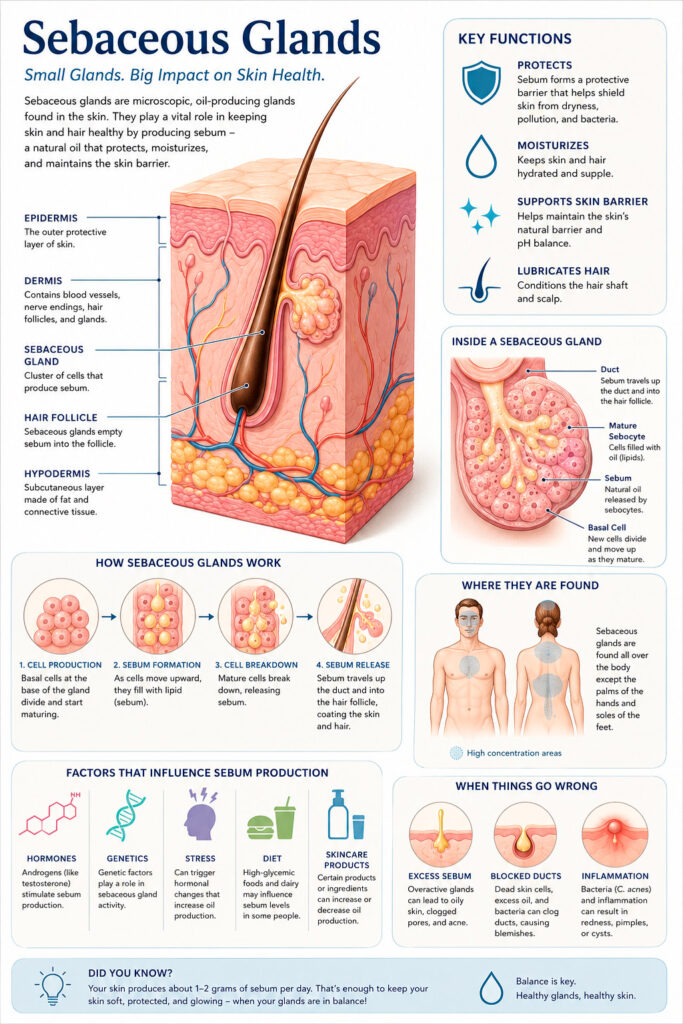
Sebaceous glands are small, sac shaped structures that live in the dermis, which is the supportive middle layer of your skin. Most of them attach to a hair follicle, and together the gland, the follicle, and a tiny muscle form a single working team that biologists call the pilosebaceous unit. You carry these glands almost everywhere on your body, with two notable exceptions. The palms of your hands and the soles of your feet have none, which is why those areas never feel naturally oily the way your forehead can. Everywhere else, from your scalp to your back, these glands sit ready to release their product whenever the skin needs it.
Tucked into the second layer of your skin sit hundreds of thousands of microscopic glands … these glands supply roughly 90 percent of the lipids that sit on your skin’s surface.
~ StatPearls
Density is where things get interesting, and it explains a great deal about why skin behaves so differently from one region to the next. A narrative review of sebum biology published in 2026 reports that glands cluster as densely as roughly 900 per square centimeter on the face while dropping to fewer than 50 per square centimeter on the forearm. That enormous gap is not random. The areas with the most glands tend to be the areas you describe as oily, shiny, or prone to congestion, while the sparse areas feel dry and tight by comparison. When you map where your skin gets greasy and where it stays matte, you are essentially drawing a picture of where your sebaceous glands gathered before you were even born.
Not every gland follows the same blueprint either. Most empty their contents into a hair follicle and ride the hair shaft up to the surface, but a smaller group opens directly onto the skin with no hair involved at all. These free standing glands appear in specific places such as the eyelids, the lips, and a few other delicate zones. The eyelid versions, known as meibomian glands, even help keep your tears from evaporating too quickly. So while the basic job stays the same, your body has quietly adapted the design to suit each location it serves.
How Sebum Gets Made and Why the Process Is So Unusual
The oil these glands produce has a name, sebum, and the way it gets made is genuinely strange compared to almost every other gland in the body. Most glands release their product by pushing it out while the cells stay intact and keep working. Sebaceous glands do the opposite. The cells inside them, called sebocytes, spend their entire lives filling up with lipids, swelling larger and larger until they burst apart completely. That self destruction is the actual moment of release, and scientists call this holocrine secretion. The sebum you wear today is literally made of dissolved skin cells that gave themselves up to create it.
This cycle runs on a surprisingly slow clock. Clinical sources note that a sebocyte takes roughly four weeks to travel from its birth at the outer edge of the gland to its final breakdown near the central duct. During that month long journey, the cell steadily packs itself with a blend of fats that includes triglycerides, wax esters, squalene, and cholesterol. By the time it ruptures, it has become a tiny, lipid rich payload. Multiply that by the hundreds of thousands of glands across your body, and you start to see how skin maintains such a steady supply of oil without you ever lifting a finger.
What strikes many people is how purposeful the whole arrangement is. The gland is not simply leaking grease. It is running a deliberate, scheduled production line where cells are grown, loaded, and sacrificed on a rotating timetable. Researchers have come to view the sebaceous gland as far more than an oil tap. It behaves like a small endocrine organ, responding to hormones and even processing them on site. That dual identity, part lubricant factory and part hormonal responder, is part of why these glands sit at the center of so many skin stories.
What Sebum Actually Does for You
It is easy to treat sebum as the enemy, especially if you have spent years blotting your face or reaching for mattifying products. The truth is more generous. Sebum forms a thin protective film across the skin’s surface, and that film slows the rate at which water escapes from inside your body. Without it, skin would lose moisture far faster and feel chronically dry, rough, and uncomfortable. The oil you sometimes resent is one of the main reasons your skin stays flexible and hydrated through changing weather and daily wear.
The benefits do not stop at moisture. Sebum carries fatty acids that help keep certain bacteria in check on the skin’s surface, which contributes to a more balanced and stable environment. It also helps deliver vitamin E, a natural antioxidant, up to the outermost layers where the skin meets the world. On top of that, the same oily film conditions your hair, keeping strands from turning brittle and dry as they grow. When you picture all of these jobs happening at once across your entire body, the idea of sebum as a nuisance starts to feel a little unfair.
There is even a barrier dimension to consider, because sebum blends with the lipids your skin cells produce to create the surface layer that shields you from the outside. This combined film helps defend against environmental stress and helps hold the skin’s natural suppleness in place. Skin that produces a healthy amount of sebum often looks plump and feels soft, while skin starved of it can look dull and feel taut. The goal, then, is rarely to eliminate oil. The goal is balance, which means giving your skin enough support that it does not feel driven to overproduce or run completely dry.

Why Some Areas of Your Face Feel Oilier Than Others
If your nose and forehead turn shiny while your cheeks stay comfortable, your sebaceous glands are the reason. The central band of the face, often described as the T zone, holds a much higher concentration of glands than the outer edges. That uneven distribution is why so many people technically have combination skin without ever naming it that way. One part of the face is running a busy oil operation while another part is barely active, and both are completely normal. The shine is not a sign that you did something wrong. It is a map of where your glands happen to be densest.
Scalp oiliness follows the same logic. The scalp is one of the richest gland zones on the entire body, which is why hair can feel greasy within a day or two of washing even when your facial skin feels balanced. The back and chest also carry plenty of glands, which explains why congestion sometimes appears in those areas during sweaty or humid stretches. Knowing where your glands concentrate can take a lot of the frustration out of skincare, because it shifts the question from what is wrong with my skin to where are my glands working hardest right now.
This regional variation also means a single product rarely suits every part of your face equally. The oilier central zone may want a lighter touch, while the drier outer cheeks may welcome more cushion. Treating the whole face as if it behaves identically tends to leave some areas over treated and others neglected. Once you accept that your glands are distributed unevenly by design, you can stop fighting that reality and start working with it. Skincare becomes less about correcting a defect and more about responding to a living, regional system.
The Hormone Connection That Changes Everything
Few things influence sebaceous glands as powerfully as hormones, and androgens sit at the top of that list. Androgens are a group of hormones present in everyone, regardless of sex, and they act like a volume dial for oil production. When androgen activity rises, the glands grow larger, the sebocytes swell, and sebum output climbs. When it falls, the glands quiet down. This is not a minor effect at the margins. It is one of the central forces deciding how much oil your skin makes at any given stage of life.
Puberty is the most dramatic example of this connection in action. Through childhood, sebaceous glands stay relatively sleepy and oil production remains low. Then puberty arrives, androgen levels surge, and the glands wake up all at once. Skin that was calm for years can suddenly turn oily, and the timing of breakouts during the teen years lines up almost perfectly with this hormonal shift. The same dial keeps turning throughout adulthood in response to natural cycles, stress, and other internal changes, which is why oiliness can rise and fall even long after the teenage years are over.
Because the gland responds so directly to internal signals, surface skincare can only do so much to change how much oil you produce at the source. Cleansing, exfoliating, and lightweight hydration can absolutely change how skin looks and feels day to day, and they can help the surface feel fresher and more balanced. What they do not do is rewrite the hormonal instructions telling the gland how busy to be. Keeping that distinction clear protects you from chasing products that promise to permanently shut off oil, which is neither realistic nor desirable. A healthier aim is to support the skin’s surface so the oil it does make feels comfortable rather than overwhelming.

How Sebaceous Glands Shift Across a Lifetime
Sebaceous glands are with you from before your first breath. They begin forming during the fourth month of fetal development, and by the time a baby is born the glands are already large and active, partly because of hormones passed from the mother. Shortly after birth those glands settle down, and oil production stays gentle throughout early childhood. This early calm is why young children rarely struggle with oily skin or congestion. Their glands are present and ready, simply waiting for the signal to ramp up.
Sebum production slows down gradually after around age 70, which is one reason mature skin often feels noticeably drier and thinner than it did in earlier decades.
~ Cleveland Clinic
That signal, as we have seen, is puberty, and it marks the start of the glands’ most productive years. Through the teens and into adulthood, oil output tends to run high, then gradually eases into a steadier rhythm as the years pass. According to the Cleveland Clinic, sebum production slows down gradually after around age 70, which is one reason mature skin often feels noticeably drier and thinner than it did in earlier decades. The same glands that once felt overactive can become quiet enough that the skin begins to crave more cushion and moisture from the outside.
This lifelong arc carries a practical message for skincare. The routine that suited your skin at twenty may feel harsh and stripping at fifty, simply because your glands have changed their output. Mature skin frequently benefits from richer, more nourishing care that helps replace the surface oils the glands no longer supply as freely. Recognizing where you are on this timeline helps you choose products that meet your skin where it actually is rather than where it used to be. Skin is not static, and neither are the glands beneath it.
When Sebum and Skin Cells Get Stuck Together
Most of the time, sebum travels up to the surface and spreads out without any trouble. Problems tend to begin when oil and dead skin cells combine inside a follicle and form a plug that scientists call a comedo. When that plug stays beneath the surface, it can show up as the small bump commonly known as a whitehead, and when the trapped material reaches the surface and darkens through contact with air, it becomes what people call a blackhead. This is a normal, well documented part of how the pilosebaceous unit can behave, especially during periods of high oil production. It is not a sign of poor hygiene, and scrubbing harder rarely solves it.
Higher sebum output, combined with the natural bacteria that live in the skin and a touch of inflammation, is closely linked to the familiar breakouts that so many people experience during their teens and beyond. The gland itself is not malfunctioning. It is doing exactly what androgens have instructed it to do, and the congestion is a downstream result of oil meeting cells in a narrow space. Because the cause is partly internal and partly structural, gentle and consistent care usually outperforms aggressive, drying tactics. Stripping the skin can actually prompt the glands to compensate, which is the opposite of what most people want.
The practical takeaway is that managing oily or congestion prone skin is less about waging war and more about keeping the surface clear and calm. Regular, non stripping cleansing helps remove excess surface oil and loosen the debris that can settle into pores, without sending the skin into a panicked overdrive. Light exfoliation can help keep dead cells from piling up and combining with sebum in the first place. None of this changes the gland at its source, but it does change the conditions on the surface where the visible trouble actually appears. Working at that level is gentle, sustainable, and far kinder to your skin over time.

Working With Your Skin Instead of Against It
Once you see the sebaceous gland for what it really is, your whole approach to oily skin can soften. This is not a defective part begging to be corrected. It is a hardworking, lifelong system that protects, hydrates, and conditions, and it deserves a little respect rather than constant battle. The most sustainable routines tend to support that system instead of trying to overpower it. That usually means cleansing thoroughly but gently, hydrating even when skin feels oily, and resisting the urge to strip the surface bare in pursuit of a matte finish that never lasts anyway.
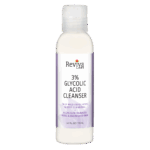
Cleansing is where many people either help or hurt their glands the most. A cleanser that respects the skin removes the day’s buildup of excess oil, sweat, and grime while leaving enough of the natural film to keep skin comfortable. Reviva Labs 3% Glycolic Acid Cleanser is one option built around that idea, designed to cleanse and refresh the complexion without leaving skin feeling stripped or tight. The point is not the product alone but the principle behind it. When you cleanse in a way that clears the surface without declaring war on your own oil, you give the glands fewer reasons to overcompensate, and skin often settles into a calmer rhythm.
Beyond cleansing, the friendliest thing you can do for your sebaceous glands is to pay attention and adjust. Notice which zones run oily and which run dry, and treat them as the distinct regions they truly are. Watch how your skin shifts with the seasons, with stress, and with age, and let your routine evolve alongside it. Skin that feels supported tends to look its best, and that support starts with knowing what is happening just beneath the surface. The more you appreciate the work these tiny glands do every single day, the easier it becomes to care for your skin with patience rather than frustration.
Frequently Asked Questions
What is the main job of a sebaceous gland?
The primary role of a sebaceous gland is to produce and release sebum, an oily substance that coats the skin and hair. This oil forms a protective film that slows water loss, helps keep skin flexible, conditions the hair, and supports a balanced surface environment. Clinical sources note that these glands supply the large majority of the lipids found on the skin’s surface, which makes them central to how comfortable and resilient your skin feels.
Why is my T zone oilier than the rest of my face?
The central band of your face, including the forehead, nose, and chin, naturally holds a far higher concentration of sebaceous glands than the outer cheeks. Because there are simply more glands packed into that area, it produces more oil and tends to look shiny sooner. This uneven distribution is completely normal and is the reason so many people have what is often called combination skin, with an oilier center and drier edges.
Can I shrink my sebaceous glands or stop them from making oil?
Surface skincare cannot permanently shut off or shrink your glands, because oil production is driven largely by internal hormones rather than by what you apply on top. Cleansing, exfoliating, and lightweight hydration can change how oily your skin looks and feels from day to day, and they can help the surface feel fresher. What they will not do is rewrite the hormonal signals telling the gland how much sebum to make, so the realistic goal is balance rather than total elimination.
Why does my skin get oilier during my teenage years?
Puberty triggers a sharp rise in androgens, a group of hormones that act like a volume dial for oil production. As androgen levels climb, sebaceous glands enlarge and produce noticeably more sebum, which is why skin that was calm during childhood can suddenly turn oily in the teen years. This hormonal surge also lines up with the timing of breakouts, since extra oil can combine with skin cells inside the follicle and create congestion.
Is sebum actually good for my skin?
Yes, sebum plays several helpful roles despite its reputation. It locks moisture into the skin, keeps the surface supple, helps keep certain bacteria in balance, and even helps carry the antioxidant vitamin E toward the outer layers. Skin that produces a healthy amount of sebum often looks plump and feels soft, while skin lacking it can feel tight and look dull, which is why dryness becomes more common as oil production naturally slows with age.
Does washing my face more often reduce oil?
Washing more aggressively or too frequently can backfire, because stripping the skin of its natural film may prompt the glands to compensate by producing even more oil. Gentle, consistent cleansing is more effective for managing oiliness, since it clears excess surface oil and debris without sending the skin into overdrive. Pairing that with light exfoliation and adequate hydration tends to keep skin calmer than harsh, drying routines ever could.
References and Sources
- Makrantonaki E, et al. Physiology, Sebaceous Glands. StatPearls. NCBI Bookshelf. https://www.ncbi.nlm.nih.gov/books/NBK499819/
- Cleveland Clinic. Sebaceous Glands: Function, Location and Secretion. https://my.clevelandclinic.org/health/body/24538-sebaceous-glands
- DermNet NZ. Sebum. https://dermnetnz.org/topics/sebum
- Encyclopaedia Britannica. Sebaceous gland. https://www.britannica.com/science/sebaceous-gland
- Review article: The Bidirectional Role of Sebum in Skin Health. PMC, National Library of Medicine. https://www.ncbi.nlm.nih.gov/pmc/articles/PMC12729757/