
Ingredients, Skin Care
How Skincare Habits and Beauty Ideals Transformed Across 14 Decades

Mar
Somewhere between the porcelain complexions of the 1880s and the barrier-repair obsession of the 2020s, something quietly remarkable happened. Skincare stopped being about concealing skin and started being about caring for it. That shift did not happen overnight. It moved slowly, decade by decade, shaped by science, war, culture, celebrity, and eventually the internet. Looking at how beauty ideals and skincare habits have changed across 140 years reveals not just a history of products, but a history of how people see themselves.
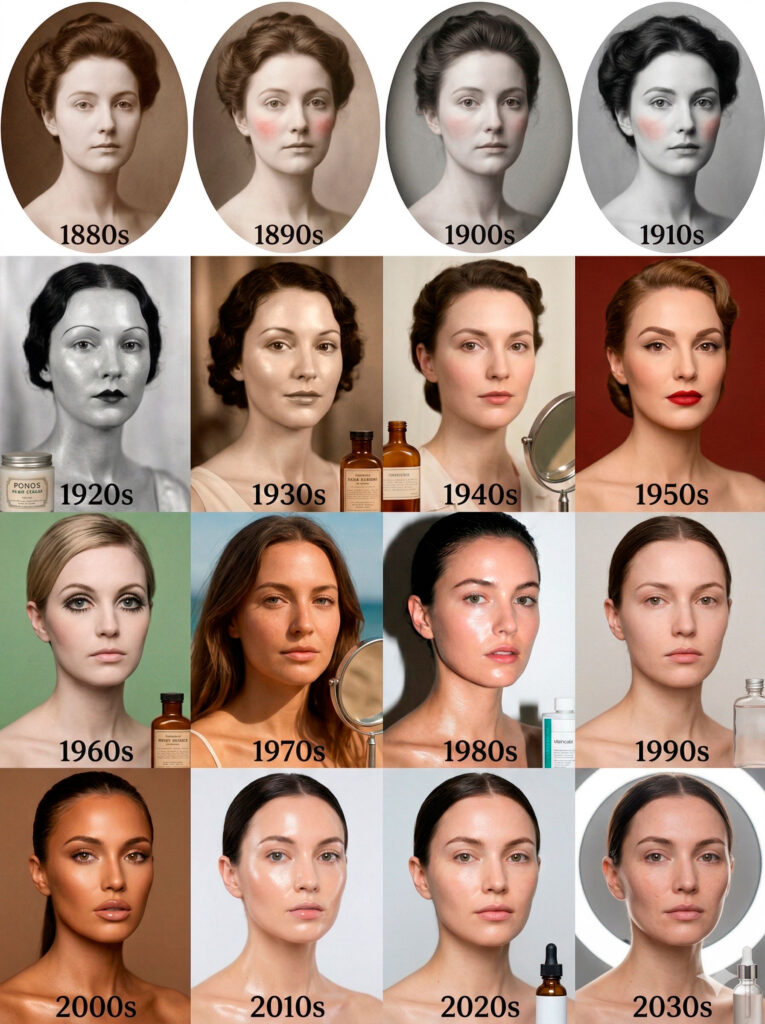
The image that inspired this article says a great deal in a single glance. Sixteen panels, sixteen eras, sixteen different ideas of what it meant to have beautiful skin. What strikes you first is how dramatically the look changes from decade to decade, and then how certain threads keep returning. Dewy skin. Luminous skin. Natural skin. The terms evolve, but the aspiration is remarkably consistent: healthy, radiant skin that looks cared for. That aspiration is the throughline connecting a Victorian woman with her cold cream to a Gen Z consumer researching ceramides at midnight.
A Victorian Standard Built on Simplicity
In the 1880s and 1890s, beauty was framed almost entirely as a matter of moral character. Fair, unblemished skin was considered a sign of virtue and class. Practical formulations like cold cream, glycerin, and rosewater dominated the limited product landscape available to women of that era. These were not frivolous purchases. They were practical tools for managing skin in climates without central heating, indoor plumbing, or any real protection from the elements. Skincare was functional before it was fashionable. The cold cream tradition, dating back to ancient Greek physician Galen, remained essentially unchanged for nearly two thousand years and was still the dominant skincare product in American households well into the twentieth century.
By the 1900s and 1910s, the beauty conversation began expanding. Mass-market advertising was new, and so was the idea that a woman could purchase her way to a better complexion. Products were still largely cold creams, tonics, and powders, but they were now being marketed with aspiration attached. The women in beauty advertisements of this era were idealized, ethereal, and deliberately pale. Skin protection from the sun was not yet understood as a health issue, but avoiding a tan was a strong cultural preference – a sign that you did not work outdoors.
The Jazz Age and the Birth of Beauty Culture
The 1920s rewrote almost every social rule, and skincare was no exception. The dewy complexion became a mark of sophistication. Pond’s Cold Cream, one of the most heavily advertised products of the era, was positioned not just as a cleanser but as the secret behind the flawless skin of society women and celebrities. This decade introduced the idea that skincare could be aspirational in a modern, urban, cinematic sense. Defined lips, luminous skin, and carefully shaped brows replaced the soft naturalism of the Victorian era. The product shelf was growing, and women were paying attention.
The 1930s brought glycerin-moisturized skin and sculpted features into vogue, heavily influenced by Hollywood. Film required a different kind of face. Under studio lighting, skin needed to hold up, glow evenly, and photograph well. That demand for photogenic skin trickled outward into general beauty culture. If your favorite actress had luminous, even skin in every close-up, that became the goal. It was also during this decade that early conversations about ingredients and formulation began appearing in beauty publications, planting the first seeds of ingredient-conscious skincare.
Wartime Minimalism and the Postwar Reinvention
The 1940s stripped beauty down to its essentials. With rationing in effect across much of the Western world, women made do with what was available. Clean, practical skin with minimal makeup became a quiet necessity reframed as a virtue. Practical skin with natural, minimal makeup was the defining aesthetic. What is striking about this era, in retrospect, is how closely it resembles certain modern skin ideals that are presented as revolutionary. Clean, well-moisturized skin with few added products was not a trend in the 1940s. It was simply what was available, and people adapted.
The 1950s swung hard in the opposite direction. With postwar prosperity came glossy magazines, department store beauty counters, and the matte, flawless complexion as the hallmark of femininity. Red lipstick and a perfect complexion became cultural shorthand for put-together womanhood. Skincare routines became more elaborate, and the product market expanded rapidly. This decade saw the early rise of branded skincare lines targeting specific skin concerns, laying the groundwork for the specialized routines that would define the decades ahead.
The Counterculture Decade and Its Lasting Influence
The 1960s introduced minimalist base makeup and the Mod aesthetic. Pale skin, graphic eyeliner, and the deliberate removal of anything fussy or ornate from the face represented a generational rebellion. Skincare took a back seat to the visual drama of the makeup itself. Yet beneath the surface, this decade was when dermatology began making more meaningful crossover into consumer beauty. Prescription-strength ingredients were starting to influence what consumers wanted from over-the-counter products.
By the 1970s, the pendulum had swung again. Sun-kissed, natural glow became the dominant ideal. Outdoor living, the environmental movement, and a cultural rejection of artifice all pushed beauty toward a more relaxed aesthetic. This is also the decade when early SPF products began appearing in mainstream contexts, though the motivation was more about controlling tan depth than preventing sun damage. Research connecting sun exposure to accelerated skin aging was accumulating in dermatological literature, but it had not yet reached the general consumer. The 1970s natural glow aesthetic is almost ironic in retrospect: the exact look most associated with sun exposure was becoming popular at the precise moment scientists were learning how damaging UV radiation truly was.
The Decade That Changed the Ingredient Conversation Forever
The 1980s were loud, maximalist, and chemically ambitious. Bright, high-shine, heavily moisturized skin paired with bold color was the signature of the era. But underneath the dramatic aesthetic, something genuinely significant was happening in skincare formulation. AHAs (alpha hydroxy acids) and retinoids began making their way into consumer conversations during this decade, initially through dermatologist recommendations and eventually through mainstream beauty media. According to research published in the Archives of Dermatology, topical tretinoin (a retinoid) was demonstrated to visibly reduce the appearance of fine lines and wrinkles, a finding that transformed the conversation about what skincare could actually accomplish. That single category of ingredient would go on to become one of the most researched and widely used in modern skincare.
The 1990s pulled back sharply. Barely-there skin, minimal coverage, and a slightly matte finish reflected a cultural move toward grunge aesthetics and an apparent rejection of the previous decade’s excess. But the skincare industry did not slow down. It simply went quieter. Under the surface of the no-makeup makeup look, SPF awareness was growing, antioxidant research was accelerating, and the professional skincare segment was expanding rapidly. Women were spending more on what went on their skin before their makeup, even when the makeup itself was minimal.
The Decade That Introduced Global Influence
The 2000s reintroduced warmth, highlight, and shimmer. Bronzed, glossy skin with visible luminosity reflected the influence of celebrity culture amplified by a new generation of tabloid media and early internet exposure. Skin prep became a real category. Primers, illuminating moisturizers, and skin-plumping serums began taking up real estate in beauty bags. This decade also saw skincare and makeup blur meaningfully for the first time, as tinted moisturizers, BB creams, and skin-finish foundations promised coverage and skincare benefit in a single product.
The 2010s produced not one but two defining aesthetic movements that reshaped the industry. K-beauty brought the concept of glass skin, cloudless glow, and layered hydration to a Western audience that had never heard of essences, ampoules, or the idea of twelve-step routines. That same decade also saw the rise of the “natural, fresh-skin, barely-there texture” ideal, which demanded excellent base skin rather than excellent coverage. For the first time, the goal was not to cover skin with product but to care for skin so well that no coverage was necessary. This shift moved significant consumer spending from the makeup aisle to the skincare aisle, and the industry responded accordingly.
Skinimalism and the Science-First Era
The 2020s introduced what the image accurately labels “skinimalism.” Barrier-focused care, minimal product layering, and barely-there coverage define the current moment. But this is not minimalism by limitation. It is minimalism by sophistication. Consumers in this decade are the most ingredient-literate in history. They read labels. They research formulations. They follow dermatologists on social media and cross-reference product claims against clinical research. A 2021 survey by the International Journal of Cosmetic Science found that ingredient transparency had become a primary purchase driver for a significant and growing segment of skincare consumers, particularly among younger adults. That transparency demand is reshaping how brands formulate, communicate, and position their products.
The skin barrier, ceramides, peptides, and microbiome support have become mainstream vocabulary. SPF use has finally crossed from a dermatologist recommendation to a broadly accepted daily habit for a wider demographic. And clean formulation – avoiding unnecessary synthetic additives, fragrances, and known irritants – has moved from a niche preference to a baseline consumer expectation. Reviva Labs, which has been formulating with clean, effective ingredients since 1969, represents the kind of brand whose approach to skincare anticipated this consumer shift by decades.
What Stays the Same Across Every Era
Every decade depicted in this visual journey reflects something distinct about its cultural moment. But certain desires never disappear. The wish for skin that looks healthy, rested, and genuinely cared for appears in every single era, even when the specific expression of it changes dramatically. Dewy in the 1920s. Luminous in the 1930s. Natural in the 1970s. Glass skin in the 2010s. Barrier-healthy in the 2020s. These are all the same aspiration wearing different aesthetic clothes.
What has changed is the mechanism. Early skincare was mostly cleanse, tone, and moisturize with whatever was available. Modern skincare draws on decades of dermatological research, ingredient science, clinical testing, and a global exchange of beauty knowledge that no previous generation had access to. The consumer of today has more information, more options, and more sophisticated expectations than at any other point in history. And yet the goal is still exactly what it was for the woman with her cold cream in 1892: skin that feels taken care of.
The journey from the 1880s to the 2020s is, in the end, a story about science catching up to aspiration. Every generation wanted healthy, radiant skin. Each one worked with the tools and knowledge it had. The tools got better. The knowledge deepened. And the conversation about what skin really needs, stripped of trend and cultural pressure, keeps arriving at the same answer: consistent care, quality ingredients, and respect for the skin’s own biology.
Frequently Asked Questions
What skincare habit from history has proven to be scientifically valid?
Cold cream, the dominant skincare product from ancient times through the mid-twentieth century, actually holds up reasonably well. Its emollient, cleansing, and moisturizing properties align with modern understanding of skin barrier function. The basic principle of cleansing followed by moisturizing remains a dermatological recommendation today.
When did SPF awareness become mainstream?
Early SPF products appeared in the 1970s, but consumer awareness of sun protection as a health and anti-aging measure grew significantly through the 1980s and 1990s as research on UV damage accumulated and dermatology messaging reached wider audiences. Daily SPF use as a broad habit is largely a product of the 2000s and beyond.
What triggered the shift from covering skin to caring for it?
The shift accelerated in the 2010s, driven significantly by K-beauty influence and the glass skin aesthetic, which demanded that base skin be the focus rather than coverage. Simultaneously, ingredient-literate consumers began questioning whether heavy coverage products were actually benefiting their skin long-term.
Why are AHAs and retinoids considered so important in skincare history?
Their emergence as accessible consumer ingredients in the 1980s represented the first time clinically validated, mechanism-based actives moved from prescription dermatology into mainstream skincare. They demonstrated that topical products could produce measurable, visible changes in skin, which fundamentally shifted consumer expectations of what skincare could accomplish.
What does “skinimalism” actually mean in practice?
Skinimalism refers to a minimal-product, maximum-efficacy approach to skincare. Rather than layering many products, the philosophy prioritizes a smaller number of well-formulated products that address the skin barrier, hydration, and protection. It is driven partly by ingredient literacy and partly by research suggesting that over-layering products can disrupt the skin’s natural microbiome and barrier function.
Has the definition of “healthy skin” changed over the decades?
Yes and no. The aesthetic expression has changed significantly, from pale and powdered in the Victorian era to bronzed in the 2000s to balanced and even-toned today. But the underlying markers of genuinely healthy skin, including hydration, intact barrier function, even texture, and absence of chronic irritation, have remained consistent in dermatological literature. What changes is which of those markers receives cultural emphasis in any given decade.
References and Sources
- Draelos, Z.D. (2009). The science behind skin care: Moisturizers. Journal of Cosmetic Dermatology. https://doi.org/10.1111/j.1473-2165.2009.00459.x
- Kligman, A.M., Grove, G.L., Hirose, R., Leyden, J.J. (1986). Topical tretinoin for photoaged skin. Journal of the American Academy of Dermatology. https://doi.org/10.1016/s0190-9622(86)70171-7
- Lim, H.W., Young, L., Honigsmann, H. (2011). American Academy of Dermatology consensus conference on UVA protection of sunscreens. Journal of the American Academy of Dermatology. https://doi.org/10.1016/j.jaad.2010.10.048
- Segger, D., Schonlau, F. (2004). Supplementation with Evelle improves skin smoothness and elasticity in a double-blind, randomized, placebo-controlled study with 62 women. Journal of Dermatological Treatment. https://doi.org/10.1080/09546630410032992
- Draelos, Z.D. (2010). Cosmetics and skin care products. Dermatologic Clinics. https://www.sciencedirect.com/science/article/abs/pii/S0733863509001156