
Ingredients, Natural, Reviva Labs, Skin Care
The Skincare Ingredient Finally Getting the Attention It Deserves – Tranexamic Acid

Aug
For years, the conversation around fading dark spots and evening out skin tone revolved around a small handful of familiar names. Vitamin C got most of the spotlight, retinol handled texture, and hydroquinone sat quietly in the background as the clinical gold standard nobody loved using. Somewhere along the way, a lesser-known ingredient started showing up in more formulas, more dermatology offices, and more actual research papers, and it deserves a proper introduction. Tranexamic Acid is not new to medicine, but its role in skincare is still relatively recent, and the science behind it is stronger than most trending ingredients ever get.
What Tranexamic Acid Actually Is
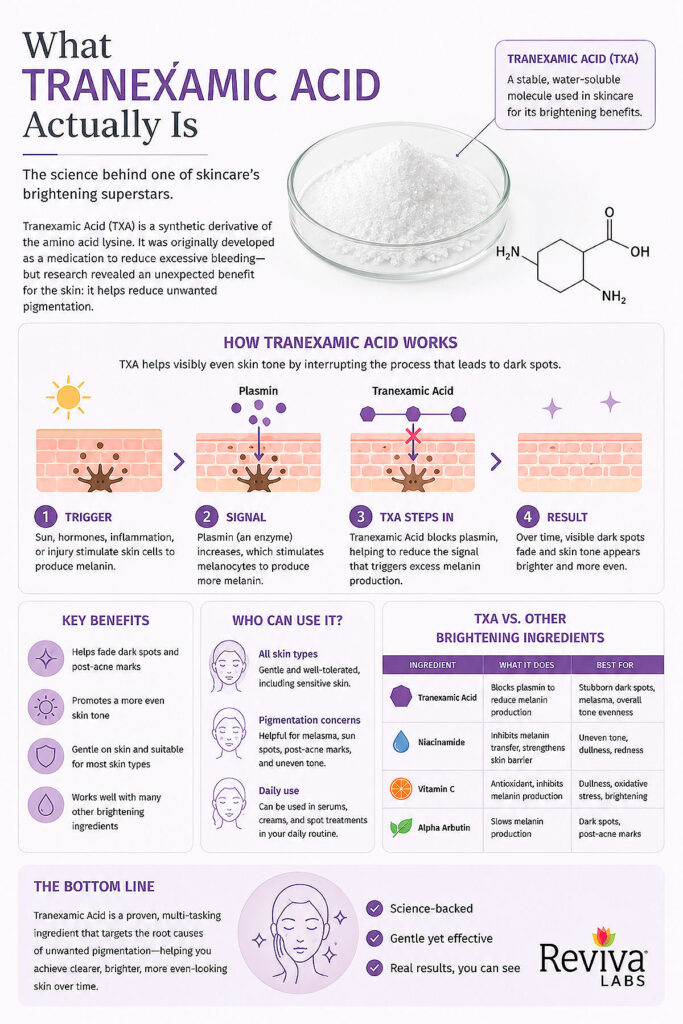
Tranexamic Acid started its life far away from skincare shelves. It’s been used for decades in medicine to help control bleeding, and its ability to calm certain biological processes eventually caught the attention of dermatologists treating stubborn pigmentation. What they noticed was that patients using it, whether orally, by injection, or applied topically, often saw real improvement in melasma and other forms of discoloration that had resisted other treatments. That clinical observation is what eventually inspired cosmetic chemists to formulate topical versions specifically for skincare use.
The way it works is genuinely a little different from most brightening ingredients on the market. Many familiar brighteners, Vitamin C and Kojic Acid among them, work primarily by interrupting the process that produces pigment in the first place. Tranexamic Acid does some of that too, but it also addresses inflammation and the tiny blood vessel activity that can worsen and prolong visible discoloration. That dual action is part of why researchers have taken such an interest in it, and why it tends to perform well even in cases where other brighteners have plateaued.
A widely cited 2017 meta-analysis published in Acta Dermato-Venereologica pooled data from eleven separate studies covering 667 participants and found that Tranexamic Acid produced a statistically significant reduction in melasma severity, whether used on its own or added to an existing treatment routine.
A widely cited 2017 meta-analysis published in Acta Dermato-Venereologica pooled data from eleven separate studies covering 667 participants and found that Tranexamic Acid produced a statistically significant reduction in melasma severity, whether used on its own or added to an existing treatment routine. The researchers noted that side effects across the pooled studies were generally minor. For a cosmetic ingredient, that is a genuinely substantial body of clinical evidence, and it goes a long way toward explaining why so many brands and dermatologists have shifted their attention toward it in recent years.

Why Timing Matters So Much With This Ingredient
If there is one thing that trips people up with Tranexamic Acid, it is expectations around timing. Skincare culture has trained a lot of us to expect visible change within a week or two, and Tranexamic Acid simply does not work that way. Clinical studies on topical formulations commonly assess results after around eight to twelve weeks, not eight to twelve days, and that runway matters enormously for how satisfied someone ends up feeling with the product.
Part of the reason for that slower timeline comes down to how discoloration actually forms in the skin. A dark spot is not sitting purely on the surface waiting to be wiped away, it reflects a buildup of melanin at different depths, some of it recent and some of it the result of months or years of accumulated sun exposure. Ingredients that work by slowing pigment production or calming the inflammatory triggers behind discoloration need time to let that existing pigment clear naturally through the skin’s normal turnover cycle. Rushing the process, or switching products every few weeks out of frustration, tends to reset the clock rather than speed anything up.
This is also where consistency starts to matter more than concentration. A well formulated product used every single day for two full months will almost always outperform a stronger formula used sporadically, because the skin needs that steady, uninterrupted signal to keep responding. Anyone starting a Tranexamic Acid based routine should genuinely plan on a season, not a sprint, and build the product into a step they already do daily rather than treating it as an occasional treatment reserved for bad skin days.

How It Pairs With Other Brightening Ingredients
One of the more useful things about Tranexamic Acid is how well it tends to play with other brighteners rather than competing with them. Because it targets discoloration through a slightly different mechanism than ingredients like Azelaic Acid, Kojic Acid, or Niacinamide, combination formulas often outperform single ingredient products, addressing pigment production, inflammation, and skin texture more or less simultaneously rather than relying on one pathway to do all the work. That multi angle approach is a big part of why so many recent brightening formulas lean on combinations rather than any single star ingredient.
Azelaic Acid in particular has become a common pairing, and for good reason. It brings its own exfoliating and anti-inflammatory properties to the table, along with a long track record for improving both discoloration and the appearance of blemished skin. Formulas that combine the two are essentially asking two well studied ingredients to tackle the same problem from different angles, which tends to produce more noticeable results than either ingredient managing the job alone.
It is worth noting that Tranexamic Acid is generally considered gentle relative to some of the more aggressive brightening options like hydroquinone or higher strength retinoids. That gentler profile makes it a reasonable option for people whose skin does not tolerate stronger actives well, though anyone with particularly reactive or sensitive skin should still introduce it gradually and watch how their skin responds over the first couple of weeks before committing to twice daily use. Starting with once daily application before working up to twice a day is a simple way to gauge tolerance without overwhelming the skin barrier.
Formulators have also gotten better at combining Tranexamic Acid with supporting ingredients that address texture alongside tone. Kojic Acid and Niacinamide both show up frequently in these blends, each bringing its own research backed brightening mechanism, which means a well-built formula is rarely relying on a single active ingredient to carry the entire routine. That layered approach tends to be more forgiving of individual variation in how different skin types respond, since a formula with three or four working parts has more paths to visible improvement than one relying on a single ingredient alone.
Building It Into A Realistic Routine
The most sustainable way to use a Tranexamic Acid formula is to treat it as a normal part of the routine rather than a special occasion product. Applying it consistently, whether that means once daily or twice depending on the specific formulation, tends to produce far better results than an inconsistent schedule driven by motivation that comes and goes. Massaging it into areas of visible concern, letting it fully absorb, and layering other steps on top afterward is generally the simplest approach and the one least likely to fall apart after a busy week.
Morning use calls for one non-negotiable step afterward, and that is sunscreen. UV exposure is one of the primary drivers of the kind of discoloration these formulas are working to correct, so skipping sun protection essentially works against everything the active ingredients are trying to accomplish. Evening use avoids that particular concern, which is part of why some people prefer to build their brightening step into a nighttime routine instead, though either timing can work well as long as it happens consistently.
Patience genuinely is the whole strategy here. Skin that has spent months accumulating discoloration from real UV exposure is not going to reverse that in a week, no matter how well formulated the product is. Committing to a full season of consistent, correctly timed use, alongside daily sun protection, gives Tranexamic Acid and its typical pairing ingredients the actual runway they need to do the work the research says they are capable of doing.
Common Mistakes That Slow Down Results
The single most common mistake is abandoning a product too early. Because Tranexamic Acid works gradually, a lot of people give up around week three or four, right around the point where the ingredient is just starting to build momentum, and switch to something new before the original product had a real chance to work. That constant switching resets the process and can leave someone feeling like nothing works for their skin, when the actual issue was simply not sticking with any one approach long enough.
Skipping sunscreen is the second big one, and it undermines the entire premise of a brightening routine. New pigment forms in response to UV exposure faster than most people realize, so applying a brightening product in the morning and then walking out the door without sunscreen is a bit like mopping a floor while the faucet is still running. Even on cloudy days or during a normal commute, UV rays reach the skin, and consistent daily sunscreen use is what protects the progress a brightening routine is trying to build.
Overdoing it is a less obvious mistake but a real one. Layering multiple strong actives at once, a Tranexamic Acid formula alongside a retinoid and a strong exfoliating acid, for example, can overwhelm the skin barrier and cause irritation that actually worsens the appearance of discoloration rather than improving it. A simpler routine, built around one or two well-chosen brightening steps used consistently, tends to outperform a crowded routine where every product is fighting for the skin’s attention.

Who Tends To See The Best Results
Anyone dealing with sun induced discoloration, the kind that builds up gradually over a season of real outdoor time, tends to respond particularly well to Tranexamic Acid based routines. Because the ingredient addresses both pigment production and the inflammatory activity that can worsen visible spots, it tends to help across a fairly broad range of discoloration types rather than being narrowly effective for just one specific cause. That breadth is part of why it has become such a common addition to general brightening routines rather than a niche treatment reserved for one particular condition.
People who’ve struggled with more aggressive brightening ingredients in the past, hydroquinone or high strength retinoids that caused irritation or peeling, often find Tranexamic Acid to be a more tolerable alternative that still delivers meaningful results over time. That gentler profile does not mean weaker, it simply means the timeline to visible change tends to be measured in months rather than weeks, which is a fair trade for a lot of people whose skin does not handle harsher actives well. It also means the routine tends to be more sustainable long term, since a product that does not cause ongoing irritation is much easier to stick with consistently.
Consistency is really the deciding factor more than any particular skin type or starting point. People who build the product into an existing daily habit, whether that is right after cleansing in the morning or as the last step before bed, tend to see meaningfully better results than people who use it inconsistently based on how their skin looks that particular week. The ingredient rewards routine far more than it rewards intensity.
Frequently Asked Questions
How long does it take to see results from Tranexamic Acid?
Most clinical studies assess results after eight to twelve weeks of consistent use, so it is reasonable to expect gradual improvement over roughly two to three months rather than a quick change within the first few weeks.
Can Tranexamic Acid be used alongside Vitamin C?
Generally, yes. The two ingredients work through different mechanisms and are commonly formulated together or used in the same routine, though anyone with sensitive skin should introduce new actives one at a time to monitor for irritation.
Is Tranexamic Acid safe for sensitive skin?
It is generally considered one of the gentler options among brightening ingredients, but every skin type reacts differently, so a patch test and gradual introduction is always a sensible approach for anyone with a history of reactive skin.
Does Tranexamic Acid replace the need for sunscreen?
No. Sunscreen remains essential regardless of what brightening ingredients are in a routine, since ongoing UV exposure is one of the main drivers of the discoloration these formulas are working to correct.
Can Tranexamic Acid be used both morning and night?
Many formulations are designed for twice daily use, but this depends on the specific product and concentration, so following the directions on that particular formula is the most reliable guide.
What is the difference between Tranexamic Acid and Azelaic Acid?
They work through different mechanisms, Azelaic Acid brings exfoliating and anti-inflammatory properties in addition to brightening effects, while Tranexamic Acid focuses more on calming the inflammatory and vascular activity tied to discoloration, which is part of why the two are often formulated together.
References
- Kim HJ, Moon SH, Cho SH, Lee JD, Kim HS. Efficacy and Safety of Tranexamic Acid in Melasma: A Meta-analysis and Systematic Review. Acta Dermato-Venereologica. 2017;97(7):776-781. https://doi.org/10.2340/00015555-2668 (also available via PubMed: https://pubmed.ncbi.nlm.nih.gov/28374042/)