
Clean Beauty, Ingredients, Natural, Reviva Labs, Skin Care
Why Sun Damage Doesn’t Stop When You Step Out of the Light

Jul
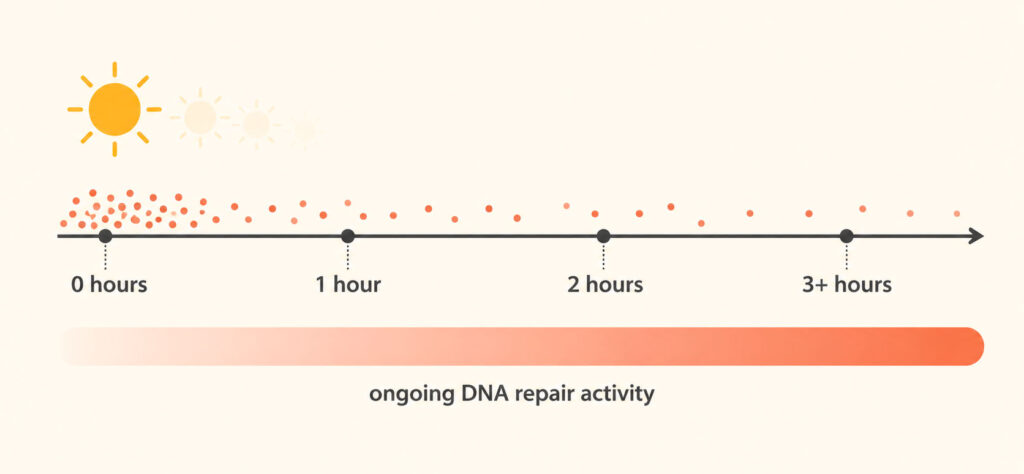
A day at the beach does not end the moment you towel off and head inside. Inside melanocytes, the pigment producing cells that give skin its color, researchers at Yale found that DNA damage from ultraviolet light kept forming for more than three hours after the light exposure had already stopped. That finding, published in the journal Science in 2015, upended a basic assumption most people carry about sun exposure. The assumption is that skin only gets hurt while the sun is actually touching it. In reality, oxidative damage from UV light behaves more like a chemical reaction that has been set in motion and simply takes time to finish playing out, long after the beach chair has been folded up.
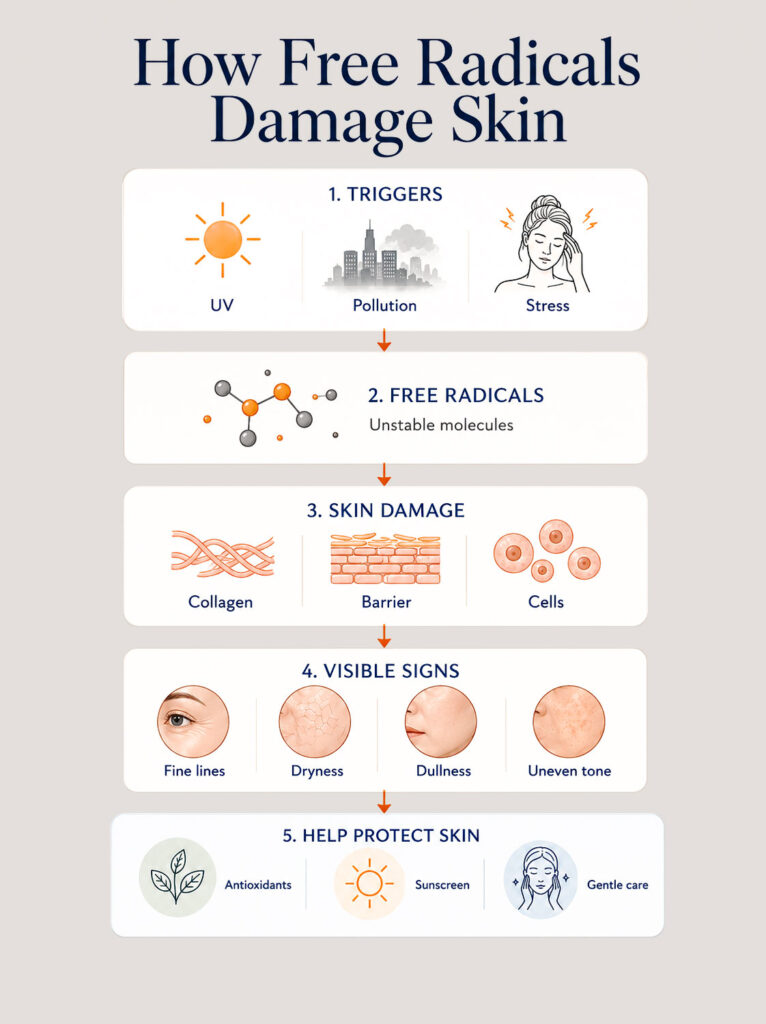
I find this particular piece of skin science genuinely useful for anyone who spends real time outdoors, because it changes how you think about an entire day, not just the hour spent in direct light. Free radicals are the actual mechanism behind nearly every visible sign of sun related skin change, from fine lines that show up years earlier than expected to uneven tone that no amount of concealer quite corrects. They are unstable molecules missing an electron, and in their search to steal one back from a neighboring molecule they set off a chain reaction that can touch DNA, collagen, and the fatty membranes holding skin cells together. Sunlight is one of the most efficient triggers of free radical formation that human skin ever encounters. Once that trigger is pulled, the resulting damage does not politely wait for the sun to set before it finishes its work.
What Free Radicals Actually Are
A free radical is simply a molecule or atom with an unpaired electron, and unpaired electrons are chemically restless. To settle down, the radical grabs an electron from whatever nearby molecule happens to have one available, and that theft turns the neighboring molecule into a new radical itself. This is how a single spark of oxidative stress becomes a cascade, moving from one molecule to the next like a row of dominoes tipping over. In skin, the most common radicals are reactive oxygen species such as singlet oxygen, the superoxide anion, hydrogen peroxide, and the hydroxyl radical, along with reactive nitrogen species like peroxynitrite. Each of these can react with lipids, proteins, and DNA in slightly different ways, but the underlying pattern of electron theft is the same across all of them.
Skin is not defenseless against this process under normal circumstances. Cells carry an enzymatic antioxidant system built around superoxide dismutase, catalase, and glutathione, plus smaller molecules such as vitamin E and vitamin C that can absorb a stray electron and neutralize a radical before it reaches something important. This defense system evolved to handle the ordinary oxidative stress of being alive, since normal metabolism generates a steady trickle of reactive oxygen species even without any sun involved. The trouble starts when a surge of new radicals arrives faster than the defense system can mop them up, and that is precisely what happens during meaningful ultraviolet exposure.
The trouble starts when a surge of new radicals arrives faster than the defense system can mop them up, and that is precisely what happens during meaningful ultraviolet exposure.
Ultraviolet light is unusually good at generating this kind of surge because it interacts directly with molecules in skin that absorb light energy, known as chromophores. Some of that absorbed energy goes toward creating reactive oxygen species almost instantly, while some of it gets funneled into enzyme systems, including NADPH oxidase, that keep producing radicals for a stretch of time afterward. Both UVA and UVB wavelengths contribute to this process, though they tend to act through somewhat different routes and reach different depths of the skin. The result is a wave of oxidative activity that begins the moment light hits skin and does not simply switch off when the light source disappears.

The Moment UV Light Reaches Skin
Within the first fraction of a second of exposure, UV photons can be absorbed directly by DNA bases, particularly thymine and cytosine, causing them to bond incorrectly with their neighbors. This direct absorption creates a lesion called a cyclobutane pyrimidine dimer, which bends the DNA strand and interferes with how that section of code gets read and copied. At the same time, and largely independent of this direct hit, UV light is triggering the indirect chain of events described earlier, where absorbed energy gets converted into reactive oxygen and nitrogen species that go on to damage nearby molecules through oxidation rather than direct light absorption. So, from the very first moment of exposure, skin cells are dealing with two separate categories of harm running in parallel, one from light hitting DNA directly and one from the free radicals that light exposure sets loose.
Melanin complicates this picture in an interesting way. For decades, it was treated almost entirely as a protective shield, since it does physically absorb and scatter incoming UV photons before they can reach deeper structures. Yet melanin itself can be excited by that absorbed energy, and once excited it becomes capable of transferring energy onward to nearby DNA, producing the same kind of dimer that direct UV absorption creates. That means melanin genuinely protects skin from a portion of incoming UV radiation while simultaneously becoming a source of additional, delayed damage on its own. It is a fair description to call melanin a molecule doing two jobs at once, one clearly beneficial and one considerably less so.
Within minutes of exposure, the oxidative signals generated by all of this activity begin switching on stress response pathways inside skin cells, most notably the mitogen activated protein kinase pathway, often shortened to MAPK. This pathway activates transcription factors including activator protein 1 and nuclear factor kappa B, which in turn instruct the cell to start producing a range of downstream proteins tied to inflammation and tissue remodeling. In other words, the free radical activity from a single sun exposure does not stay contained to a burst of chemical damage in the moment. It sets off a signaling cascade that keeps unfolding inside skin cells well beyond the initial trigger, shaping what happens to that patch of skin over the following hours and days.

The Damage That Keeps Going After You Are Back Inside
This is where the research becomes genuinely surprising, and where the opening statistic of this piece comes from. In the 2015 Science study led by researchers at Yale, scientists exposed mouse and human melanocytes to a UV lamp and then measured how much DNA damage, in the form of those cyclobutane pyrimidine dimers, appeared over time. Cells without melanin generated dimers only while the UV light was actually striking them, which matched the old assumption. Cells containing melanin, however, kept generating new dimers for more than three hours after the light source had been switched off entirely, a phenomenon the researchers termed dark CPDs to distinguish them from the dimers created instantly by direct light absorption.
The free radical activity from a single sun exposure does not stay contained to a burst of chemical damage in the moment. It sets off a signaling cascade that keeps unfolding inside skin cells well beyond the initial trigger
The mechanism behind this delayed damage turned out to involve two enzymes that, once activated by the original UV exposure, combined to excite an electron within fragments of melanin. That excited energy state then transferred to nearby DNA in the dark, producing structurally identical damage to what light itself had caused earlier, a process the researchers named chemiexcitation. Roughly half of the total cyclobutane pyrimidine dimer damage measured in these melanocytes turned out to be dark CPDs rather than dimers formed during the actual light exposure, which is a striking split when you consider that the entire premise of sun protection has traditionally centered on the minutes spent physically under UV rays. Later work in animal models found that this delayed CPD accumulation tends to peak somewhere around one to two hours after UVA exposure ends before gradually declining as the cell’s own repair systems catch up.
Follow-up research has since confirmed that dark CPDs are not a minor footnote. In cultured human and mouse melanocytes, dark CPDs make up the majority of the cyclobutane pyrimidine dimers found in the cell, and they appear to be especially pronounced in skin containing pheomelanin, the reddish toned pigment more common in fair, blond, or red toned skin. That skew toward pheomelanin rich skin is part of why researchers have been paying closer attention to how UVA specifically interacts with pigment, since UVA is the wavelength most strongly implicated in the chemiexcitation process. None of this erases the genuine protective value melanin provides against direct UV absorption, but it does mean the story of sun exposure has an entire second chapter that plays out quietly after everyone has already gone inside, closed the curtains, and stopped thinking about sunscreen for the day.
How Free Radicals Break Down Collagen and Elastin
The DNA damage discussed above is only part of what free radicals do to skin. The same oxidative surge that produces dark CPDs also drives the MAPK signaling pathway toward activating a family of enzymes called matrix metalloproteinases, commonly abbreviated as MMPs. These enzymes exist in skin naturally and play a normal role in tissue maintenance, but UV triggered oxidative stress pushes their production well beyond typical levels, particularly MMP-1, MMP-3, and MMP-9. Once elevated, these enzymes go to work cleaving and breaking down collagen and elastin, the structural proteins responsible for skin’s firmness and resilience.
Elevated MMP activity has been measured in skin for a full twenty-four hours or longer after a single UV exposure, meaning the collagen degrading enzymes triggered by an afternoon outdoors are still actively working well into the following day.
This breakdown process is not instantaneous, and that is an important point often lost in conversations about sun damage. Elevated MMP activity has been measured in skin for a full twenty-four hours or longer after a single UV exposure, meaning the collagen degrading enzymes triggered by an afternoon outdoors are still actively working well into the following day. At the same time, UV exposure suppresses the skin’s own collagen synthesis, so the skin is simultaneously breaking existing structural protein down faster while making less new protein to replace it. Repeated over years of cumulative exposure, this imbalance between degradation and synthesis is a central driver of what dermatology literature refers to as photoaging, distinct from the aging that would occur from time alone.
None of this happens in one dramatic event. It happens in small increments, exposure after exposure, most of which are never severe enough to cause a sunburn or any visible sign at the time. A short walk to the car, a window seat on a train, or an afternoon of yard work can each contribute a small dose of this same oxidative and enzymatic cascade, even on days that never felt like real sun exposure. Over years, these small and largely unnoticed increments accumulate into the texture changes, fine lines, and uneven tone that people eventually associate with photoaged skin.

Why Antioxidant Reserves Run Out So Fast
Skin’s built in defense against all of this oxidative activity depends heavily on a limited pool of antioxidant molecules, and that pool gets consumed quickly once UV exposure begins. Vitamin E sits primarily in cell membranes and the lipid rich outer layer of skin, where it is well positioned to intercept radicals before they damage fats and membrane structures. Vitamin C occupies more of the watery compartments of skin and works alongside vitamin E in a kind of relay system, regenerating spent vitamin E molecules so they can continue neutralizing new radicals. Both, however, are finite resources that get used up as they do their job, rather than being continuously replenished in real time.
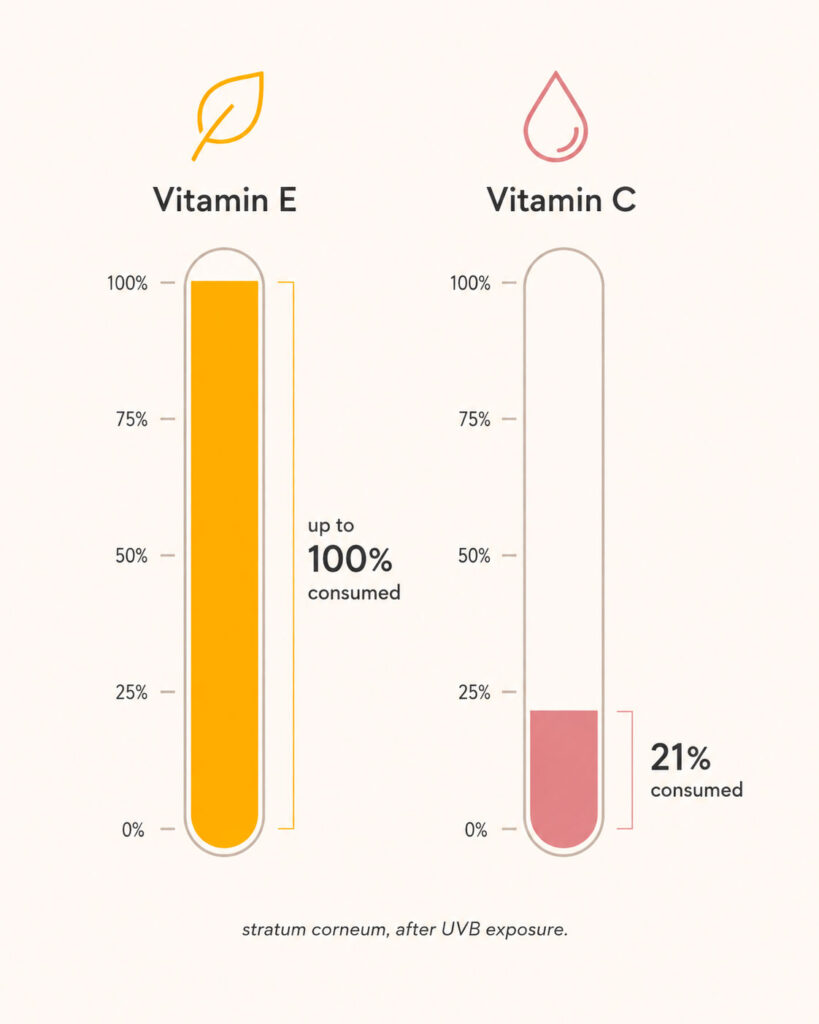
A frequently cited pig skin study illustrates just how quickly this depletion happens. After UVB irradiation, researchers measured vitamin E consumption of up to one hundred percent in the outer skin layer and the viable epidermis beneath it, alongside a smaller but still meaningful twenty one percent depletion of vitamin C in the outer layer. In practical terms, a single meaningful UV exposure can functionally exhaust the skin’s most accessible antioxidant reserves in that immediate area, leaving considerably less defense available for the hours of continued oxidative activity that follow, including the dark CPD formation described earlier. Separate research on human skin has shown that even a dose of UV light too mild to cause visible redness can measurably deplete stratum corneum vitamin E, making that depletion one of the earliest detectable markers of UV related oxidative stress, well before any sunburn would ever appear.
This helps explain why the hours immediately following meaningful sun exposure are not simply a quiet aftermath. They are, biochemically speaking, a period when skin has fewer of its own resources available precisely while free radical activity, delayed DNA damage, and MMP driven collagen breakdown are all still actively underway. Two separate stressors are effectively overlapping in that window, one depleting the raw materials needed for defense and the other continuing to generate new radicals that need defending against. It is a mismatch between ongoing demand and a depleted supply, and it is part of why dermatology researchers describe UV exposure as leaving a kind of oxidative debt that skin has to work through over the following day rather than settling immediately.

The Cumulative Toll of Repeated Exposure
Any single exposure eventually resolves as repair enzymes correct most DNA lesions and antioxidant levels slowly rebuild. The concern is not really any one afternoon in the sun. It is the accumulation of thousands of these small, mostly invisible cycles of oxidative stress and repair across years and decades, each one leaving behind a slightly incomplete recovery. A dimer that gets repaired imperfectly, a stretch of collagen that gets degraded slightly faster than it is replaced, a patch of pigmentation that shifts just a bit after inflammatory signaling from one exposure meets another. None of these individual events are dramatic, yet their sum is exactly what dermatologists are describing when they distinguish photoaging from the aging that would occur purely from the passage of time.
It is also worth noting that this cumulative exposure is not limited to obvious sun-soaked days. UVA light, which plays a substantial role in both the direct signaling pathways and the dark CPD phenomenon, passes through cloud cover and ordinary window glass far more readily than UVB does. That means a commute, a desk near a sunny window, or an overcast afternoon spent outside can each contribute a real, measurable dose of the same oxidative processes described throughout this piece, even without any sensation of being sunburned or overheated. People tend to mentally file sun exposure under specific, memorable events like beach trips or long hikes, when in reality a meaningful share of lifetime UV exposure happens incidentally, in ordinary daily moments that rarely register as sun exposure at all.

What Actually Helps Once the Cascade Has Started
None of this research suggests that daily habits are pointless, and it should not be read as an argument for skipping sun protection because damage happens regardless. Broad spectrum sunscreen remains the most effective way to reduce how much UV energy reaches skin cells in the first place, since preventing the trigger is always more effective than managing its aftermath. That principle holds true precisely because so much of the damage described in this piece traces back to how much UV energy skin absorbed to begin with, not to any failure of the skin’s response after the fact. Reapplying every couple of hours during real outdoor exposure, seeking shade during peak midday hours, and wearing protective clothing when practical all reduce the total oxidative load skin has to process on any given day, which matters given how long that processing continues after the exposure itself ends.
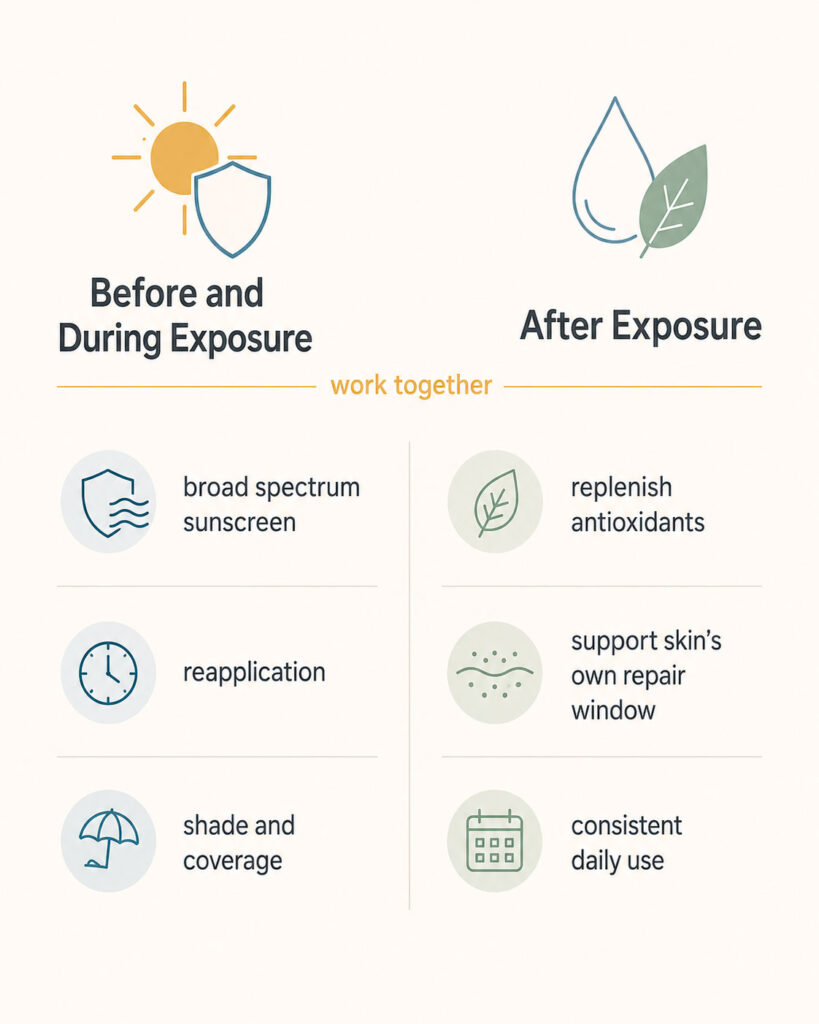
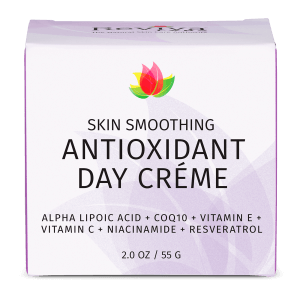
Where the dark CPD and antioxidant depletion research becomes genuinely useful is in thinking about what happens after exposure, since that window is clearly not biochemically neutral. Topical antioxidants, when applied consistently, can help replenish some of what gets depleted during and after UV exposure, giving skin more raw material to neutralize ongoing radical activity during that extended aftermath period. Some research on topical vitamin E specifically has found a measurable protective effect even when applied several hours after UV exposure had already occurred, which lines up with the idea that the damage window extends well past the moment of direct sun contact. It is worth being honest about the limits here too, since no topical antioxidant fully halts a process like chemiexcitation once it is underway, and none of this research suggests that any serum can substitute for reducing UV exposure in the first place. The realistic framing is that daily photoprotection reduces how much oxidative work skin has to do, while supporting the skin’s antioxidant reserves gives it more capacity to handle whatever oxidative work still occurs, and the two work as complements rather than either one replacing the other.
What this body of research really changes is the mental model people carry around about sun exposure. Skin is not simply reacting to UV light in the moment and then returning to a neutral baseline once you step indoors. It is running an active chemical process that continues for hours, drawing down antioxidant reserves and generating both DNA damage and enzyme activity long after direct exposure has ended. Recognizing that timeline does not require alarm, but it does make a reasonable case for treating the hours after meaningful sun exposure as part of the same skincare conversation as the hours spent in it, rather than as an afterthought once the sun has already gone down.

Frequently Asked Questions
How long do free radicals keep affecting skin after sun exposure ends?
Research on melanocytes has found that UV related DNA damage, in the form of dark cyclobutane pyrimidine dimers, continues forming for more than three hours after UVA exposure stops, with related enzyme activity such as MMP induction remaining elevated for twenty-four hours or longer. The exact duration varies by tissue and exposure level, but the pattern consistently shows meaningful oxidative activity persisting well past the moment of direct sun contact.
Is melanin protective or harmful when it comes to free radical damage?
Both, in different ways. Melanin does absorb and scatter a portion of incoming UV light before it reaches deeper skin structures, which is genuinely protective. At the same time, once melanin itself absorbs UV energy, it can become excited and transfer that energy to nearby DNA, contributing to the delayed dark CPD damage described in this piece. The two effects happen simultaneously rather than canceling each other out.
Are free radicals only caused by ultraviolet light?
No. Free radicals form constantly in skin as a normal byproduct of metabolism, and they can also be triggered by pollution, cigarette smoke, and certain forms of visible and infrared light. UV exposure is simply one of the most efficient and well-studied triggers, which is why it receives so much attention in skin research, but it is not the only source of oxidative stress skin encounters.
Can antioxidants stop free radical damage once it has already started?
Antioxidants can help neutralize ongoing free radical activity by donating an electron to an unstable molecule before it damages something else, and topical antioxidants applied after exposure have shown measurable benefit in research settings. They do not fully halt every mechanism involved, including the chemiexcitation process behind dark CPDs, and they work best as a complement to daily sun protection rather than a replacement for it.
Does cloudy weather or being indoors near a window eliminate this kind of damage?
Not entirely. UVA light, which plays a significant role in both direct and delayed free radical activity, passes through cloud cover and ordinary window glass more readily than UVB light does. That means meaningful UV exposure, and the oxidative processes it triggers, can occur on overcast days or while sitting near a sunlit window, even without any sensation of sunburn.
Why does this delayed damage matter more for people with certain skin tones?
Because the dark CPD mechanism depends on melanin, research has found this delayed damage to be especially pronounced in skin containing higher levels of pheomelanin, the reddish toned pigment more common in fair, red, or blond toned skin. This does not mean deeper skin tones are exempt from UV related oxidative stress, since the broader free radical and MMP driven processes described in this piece affect all skin tones, but it does help explain some of the variation researchers observe between individuals.
References
- Premi S, Wallisch S, Mano CM, et al. Chemiexcitation of melanin derivatives induces DNA photoproducts long after UV exposure. Science. 2015;347(6224):842-847. doi:10.1126/science.1256022. https://pubmed.ncbi.nlm.nih.gov/25700512/
- Yale University. Sunlight continues to damage skin in the dark. Yale News. February 19, 2015. https://news.yale.edu/2015/02/19/sunlight-continues-damage-skin-dark
- Haywood R, Wardman P, Sanders R, Linge C. Sunscreens inadequately protect against ultraviolet-A-induced free radicals in skin: implications for skin aging and melanoma? J Invest Dermatol. 2003;121(4):862-868. https://www.sciencedirect.com/science/article/pii/S0022202X15400764
- Dreher F, Gabard B, Schwindt DA, Maibach HI. Topical antioxidant vitamins C and E prevent UVB-radiation-induced peroxidation of eicosapentaenoic acid in pig skin. Br J Dermatol. 1998. https://pubmed.ncbi.nlm.nih.gov/11893242/
- Marionnet C, Grether-Beck S, Seite S, Krutmann J, Bernerd F. The damaging effects of long UVA (UVA1) rays: a major challenge to preserve skin health and integrity. Int J Mol Sci. 2022. https://pmc.ncbi.nlm.nih.gov/articles/PMC9368482/
- Photoaging: molecular mechanisms, clinical impact, and treatment strategies. Narrative review, 2025. https://www.researchgate.net/publication/395917463_Photoaging_molecular_mechanisms_clinical_impact_and_treatment_strategies